Odoo, implemented around how your business actually runs
Not a software install.
We map your processes, build the system around them, migrate your data,
with the full scope agreed before anything is configured.
—= Who this is for =—

Running on spreadsheets
Running finance, stock or HR across spreadsheets and disconnected tools, and losing hours reconciling them every month
Odoo that was never finished
Already on Odoo, but it was configured in a rush or by a partner who's no longer answering calls

Outgrowing one person's head
Growing past the point where one person can hold the whole business in their head
—= What you're actually buying =—
Odoo implementation is the work of turning Odoo from a blank system into the one your team runs the business on. That means:
Choosing the right modules for how you sell, buy, stock, invoice and report
- not every
module Odoo offers -
Configuring workflows, approvals, user roles and dashboards around your actual process, not a generic template
Migrating clean data from wherever you run today, Excel, QuickBooks, Tally, or another Odoo instance that never worked properly
Setting up NBR VAT, bilingual invoicing and BHD handling correctly from day one
Testing with your team's real transactions, and training the people who'll use it daily, not just management
A software installation takes a day. An implementation is a project, and it's scoped and priced like one before we start.
—= How we run an implementation =—
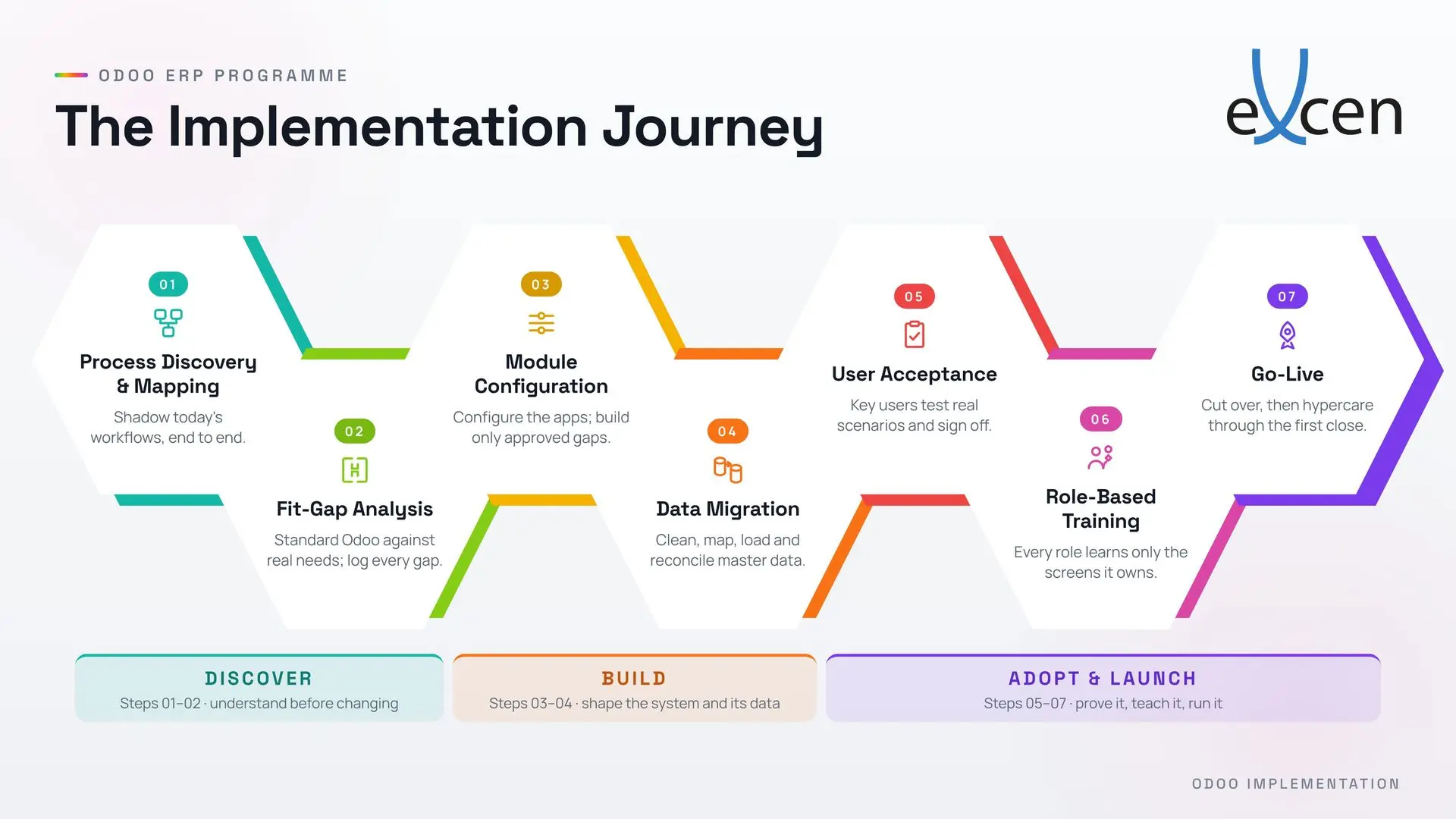
1. Discovery & process mapping
We sit with each department, not just management, and document how work actually happens today including the workarounds nobody put in the process document.
2. Solution design & fit-gap document
What Odoo covers out of the box, what needs configuration, what needs custom development. You approve this before anything is built it becomes the fixed reference point for the rest of the project.
3. Configuration & data migration
We build against the approved scope, then migrate and reconcile your historical data before go-live, not after.
4. UAT & training
Your team tests with real transactions, real invoices, real stock movements not demo data, before we agree to cut over.
5. Go-live & hypercare
We're on hand for the first month-end close, the first VAT return, the first payroll run. That's where implementations that looked fine in testing usually surface their real problems, and it's not the point to leave you on your own.
Seven stages from mapping how the business runs to a supported go-live, grouped into three phases.
—= Beyond standard configuration =—
Most implementations need at least one of these. We scope them in from the start if we already know, or add them once the fit-gap analysis makes the need clear.

Custom Development
Where standard Odoo doesn't cover a process you're not willing to change.

Connectors & integrations
Payment gateways, Biometric, banks, WhatsApp, POS hardware, shipping.


What you actually get
Signed fit-gap document · configured production and staging environments · migrated and reconciled data · training materials in writing · a named support contact for the AMC period that follows.
—= FAQ =—
Depends on scope. A focused, single-entity implementation with clean data can go live in 6–10 weeks. Multi-branch, multi-module projects with custom development typically run 3–5 months.
You'll get a specific timeline in the fit-gap document, not a guess.
Community is free and open-source; Enterprise adds official modules (advanced accounting, manufacturing, HR/payroll features, native support) and a support agreement with Odoo directly.
Most GCC businesses running proper accounting and payroll end up on Enterprise. We'll size this during discovery rather than defaulting to one or the other.
Yes. Data migration is scoped as part of every implementation — cleaning, mapping, importing and reconciling before go-live, so you're not carrying errors from the old system into the new one.
We recommend one. The weeks right after go-live are when real usage surfaces the questions testing didn't catch.
Our AMC covers that period and beyond, with tracked hours and a named contact.
That's normal, and it's part of what discovery is for.
We size the module list against your actual processes during the fit-gap phase — most businesses come in with a rough idea and leave with a shorter, more accurate list than they expected.
Let's map your processes first
then talk software.